
Aaron Bushnell Emergency Vigil
Today is the two year anniversary since Aaron Bushnell self-immolated for the Palestinian cause. These were my thoughts immediately after attending the emergency vigil in Times Square.

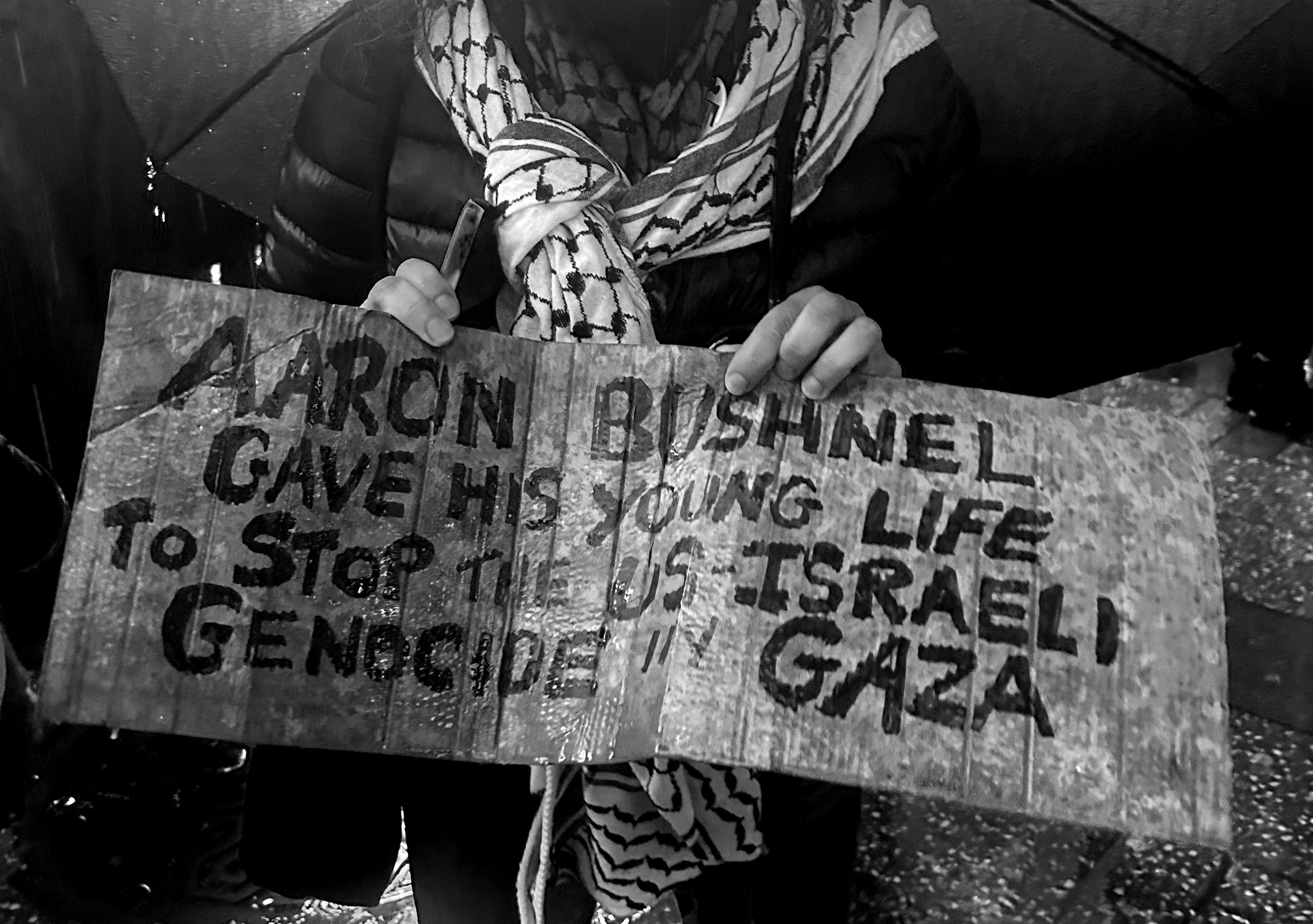
February 26, 2024
I was running a little late because my maintenance man stayed longer than anticipated. The rain nearly deterred me but that felt disrespectful to the suffering of both Aaron Bushnell and the Palestinian people living in tents currently. Enduring some rain to return to my warm home hours later is a privilege. So I put on my roommate’s rain jacket and left. Anything other than Arabic music felt wrong, but it also didn’t feel quite right. Perhaps I should have ridden the train in silence but I didn’t.
… Khadti minni rouhi, ‘omri, ‘ali we syibni bi aalbi ‘aleel …
… You took my soul, my life, my mind, and you left me with a sick heart …
It was raining even harder when I arrived at Times Square. Emerging from the subway I expected to hear the cries for justice from afar, but I had to walk at least a block or two before ‘Free Free Palestine’ could lead me to the crowd. As I neared the vigil I overheard two men snicker and say something to the effect of “Well that’s just it, we don’t agree with them” as they walked in the opposite direction. Somehow they made it sound like a slur. As I entered the crowd, I began to wonder how many were just onlookers. Tourists making a spectacle of us. As I neared the center, the steady increase in keffiyehs eased my worry.
Times Square was walled with policemen. Attendees on the outskirts of the crowd photographed them to their clear dismay. I felt safer knowing they were being documented than knowing they were there. Then I noticed I couldn’t hear anything the speakers were saying. From the largest to the smallest protests I have attended, this is always the problem. Something about noise disturbance prohibits the use of megaphones. I think of Martin Luther King Jr.’s speeches. I wonder if they had this problem then too. I wonder if they did, did they listen? If they did, how could they have gained the traction and support it did then? Why is there no one doing it like that now? With the invention of social media more people can hear what needs to be said. But also, more people are talking. Maybe The voice of a generation is being drowned out. Maybe it’s all intentional.
We repeat the typical chants.
From the river to the sea, Palestine will be free.
From the sea to the river, Palestine will live forever.
From the belly of the beast, hands off the Middle East.
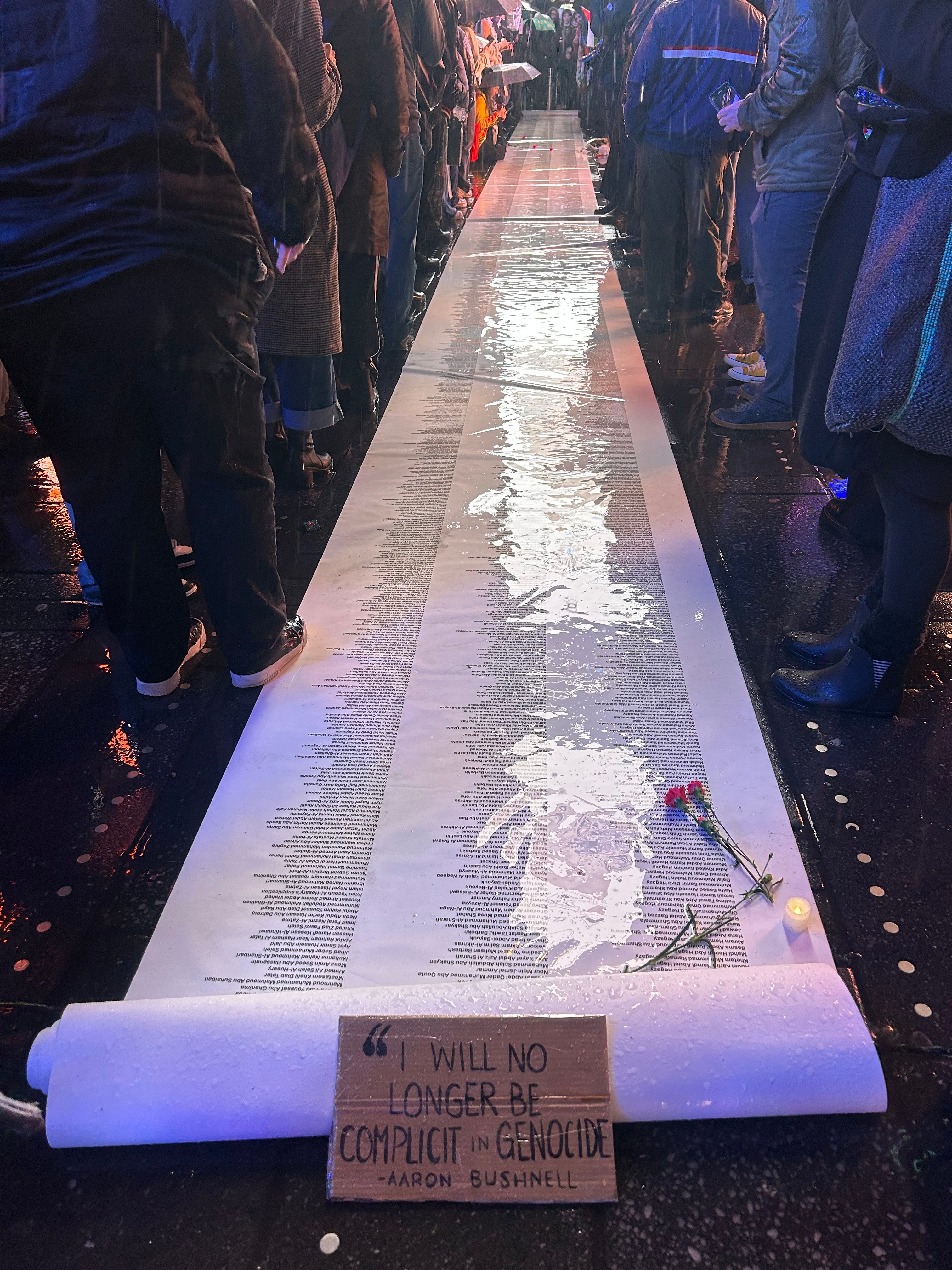
Whenever I did hear something from the speakers, I couldn’t help but notice the exhaustion in their voices. I took a loop around the crowd to see if I could hear any better elsewhere. From the looks of the crowd, no one could hear. The protest suppression has gotten out of hand. I overheard conversations of weekend plans and trivial matters. People looked demobilized even as they stood in the rain, in an act of mobilization and resistance. I’m sure I looked no different. I encroached near the front on the right to take a photo of the list of martyrs on the ground. Someone stepped on it as they crossed. I watched them make this decision, then look around pretending as if it were an accident. Every minute that passed drenched me more and more. The rain was becoming unpalatable. Most people in the crowd had an umbrella or were with someone who had one. Many looked at my drenched clothes in pity. No one offered to let me stand under their umbrella, though I also didn’t ask. My boots filled with water as I sloshed my way almost directly to the right of the speakers and still struggled to hear everything.
I know they spoke of martyrdom and how self-immolation is revered by the West as the singular most desperate act of ‘non-violent’ protest, but is now rolling back on the belief. Now it’s mental illness. Apparently, self-immolation is only heroic when it’s another brown person dying* and its effect is destabilizing a country in the Middle East. They also said that Aaron Bushnell’s sacrifice is a landmark escalation in the collective consciousness. I find that to be the part that deniers cannot grasp. That Aaron’s sacrifice, while perhaps rooted in a kind of depression and desperation, was also an incredible act of morality. He understood the gravity of his position as an active-duty white male soldier in the United States Air Force, and he felt desperate enough to follow through on making the ultimate statement. Not only to make himself a martyr, not only to unveil the United States for the morally corrupt tyrannical regime they are but also to mobilize you. To ask you, if I am willing to endure this, what are you willing to endure?
A girl appeared from seemingly nowhere to place flowers and a candle on the list of martyrs and disappeared back into the crowd just as swiftly. I eventually decided my everything was too soaked to remain put and I trekked home. I put my keffiyeh in my bag just in case.
In November, when the Gazan death toll rocketed over 10,000, I considered starving myself. I thought about civilian assassinations of political figures, and how much more difficult they are to execute nowadays. I thought about burning myself. The idea was quickly thrown out as I realized my death would mean as much to the world as a Palestinian death. Another Arab girl gone, hysteric and depressed. A statistic. Aaron Bushnell was a white male soldier in active duty. His desperation had been publicized tenfold, albeit his intention was often obscured. To refresh the collective memory, Aaron Bushnell self-immolated in front of the Israeli embassy in Washington DC on February 25th, 2024. His last words were,
“I am an active duty member of the United States Air Force. I will no longer be complicit in genocide. I’m about to engage in an extreme act of protest, but compared to what people have been experiencing in Palestine at the hands of their colonizers, it’s not extreme at all. This is what our ruling class has decided will be normal. Free Palestine.”
He screamed Free Palestine until his body collapsed in flames and his lungs could not carry his voice any longer.
Self-immolation is recognized as the singular most gruesome and desperate act of protest by many, and as a meaningless act of mental illness by some. Those people often forget that the presence of mental illness is not the absence of moral clarity.
Revolution is violent. Revolution is gruesome. Revolution takes great sacrifice. Sacrifice which many of us will never be brave enough to both understand and enact. The revolutionary mind must understand this, and learn to be comfortable with it. It does not mean that these people are inherently bad, nor are they inherently good. It certainly doesn’t mean that the struggle and sacrifice endured by revolutionary movements is not valid, moral, or effective. We often make judgments based on a moment, a snapshot of their abilities and not their hearts. As frustrating as it may be, the nature of revolutionary movements will help even the people most resistant to it. We must remember the intention of change, we must remember the revolution’s purpose. Liberation is for everyone, even those that reject it. That is why the plight of the Palestinians is not simply a ‘foreign affair’, but a cause emblematic of a larger collective ordeal.
As the Palestinian people have already been subjected to the abject and made abject themselves, we must lift our perspective away from the far away reality and liken the ongoing genocide to ourselves. To reverse the abject, we must bring the conflict into our lives, and realize that these foreign lands are much like our own. These foreign people are much like us. They just want to go home.
Palestinians have been subjected to abject horror since Israel’s inception and arguably before. We face a trolley problem of sorts, a fork in the road where on one side lies our society, not as it is but as it could be. A place where there is justice, liberation, and freedom for all. A world where we are all humanized and worthy of self-determination. A world where the government listens to the people and works for them, not for profit or power. A world where our mental and physical well-being across the board is improved, a world where we feel generally taken care of.
On the other side of the tracks are our bodies. Our corporeal forms. A lifespan of an average of 70 to 80 years. A fragile and fleeting existence. While each life is important and valued, is any one life more important than the future of the world? Aaron Bushnell saw his life as a vessel for change, just as many revolutionaries do. Willing to die for the cause. While not every revolutionary-minded person must or should die for the cause, those that do keep the stakes of the cause fresh in our minds. That was the purpose of Aaron Bushnell, and also, perhaps more controversially, the purpose of hostages being taken for liberation.


Note: My takes are not meant to be inflammatory, these are my personal musings after witnessing a national outrage as written in my journal.
Rest in Peace Aaron Bushnell. Rest in Peace to all 70,000+ of our Palestinian martyrs. Free Palestine. The only thing more powerful than hate, is Love.